
In recent years, synthetic biology has emerged in many fields, and it is also playing an increasingly important role in the detection of pesticide residues. Based on the guiding ideology of synthetic biology modularization and engineering, the diverse combination of various genetic components provides more solutions for pesticide residue detection.

Image source: Web of Science
Ⅰ.Why Use Synthetic Biology to Detect Pesticide Residues?
Chemically synthesized pesticides are the most widely used pesticides with the most significant toxic and side effects, including organophosphorus, organochlorine, pyrethroids, and carbamates. Although this kind of pesticide effectively avoids the pests and diseases of crops and improves the yield, but with the continuous expansion of its application range, the pollution of the environment and the harm to animals and plants are also revealed, directly threatening human health.

Image source: pixabay
Effective detection of pesticide residues is an important link to ensure human health and safety. However, traditional pesticide residue analysis techniques have been difficult to meet the actual needs of diverse safety detection. Modern new biotechnology has the advantages of strong specificity, high sensitivity, simplicity and speed. , has been widely used and continuously developed in the detection of pesticide residues.
Taking the field of environmental remediation as an example, strains transformed by synthetic biology can effectively detect and degrade a variety of environmental pollutants, including the detection of pesticide residues.
Ⅱ.Synthetic biology applied to pesticide residue detection
In recent years, the idea of modularization and engineering of synthetic biology has been gradually applied to the field of pesticide residue detection, mainly using the following principles:
01.whole cell biosensor
Synthetic biology techniques can construct modular gene circuits in bacteria and establish whole-cell biosensors capable of detecting specific types of pesticides.
1. Hydrolytic enzymes displayed on the surface
Enzymes for specific pesticide residues can degrade pesticide residues into small molecules or characteristic compounds that are easier to detect, and the content of pesticide residues can be indirectly determined by detecting the degradation products.
Synthetic biology technology transfers the degradation pathway in the original host bacteria to bacteria that can be easily manipulated genetically, and successfully constructs an efficient pesticide residue detection engineering strain. At the same time, in order to avoid the inefficient transmembrane transport of pesticides and the loss of transport, degrading enzymes are often expressed on the surface of bacteria through a surface display system, and the degradation and detection of pesticide residues are achieved by means of in vitro catalysis.
2. Transcription activation response
Transcription regulators can bind specific pesticide compounds to act on the corresponding promoters to start the transcription process. The characteristics of the diversified combination of operon and reporter gene make it possible to combine and use gene elements with different intensities or even responding to different pesticides, and can be flexibly regulated, and have a wide range of applications.
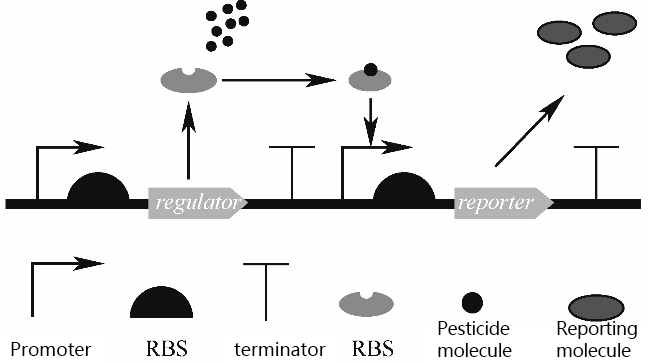
A variety of pesticides and their degradation products have the function of interfering with the endocrine of cells, exhibiting estrogen-like or anti-estrogen-like effects, so endocrine disruptor screening tests can be used to detect pesticide residues. Using this characteristic, a series of pesticide residue detection methods such as yeast transcriptional activator gene (GAL4) binary system have been developed.
02.Cell-free synthetic biology
Cell-free synthetic biology refers to the transcription and expression of constructed engineered circuits in a cell-like system (containing the necessary components for cell expression) in a cell-free chassis, which can precisely control the mixing ratio of each component,Combined with simple mathematical modeling, the detection is more accurate.
The cell-free synthetic biology method has looser requirements for the detection environment, can work in a highly toxic environment, and is suitable for the detection of various pesticide residues. At the same time, it can also avoid problems such as low efficiency of pesticide transport into cells and gene mutation of recombinant bacteria.
Cell-free biosensors using luciferase as a reporter gene have been successfully used in the detection of transcriptional inducers.
Ⅲ.Application of Synthetic Biology in Pesticide Residue Detection
The use of biotechnology for accurate detection of pesticide residues can not only ensure the quality and efficiency of pesticide residue detection, but also make positive contributions to the protection of people’s lives and promote the harmonious and stable development of our society.
01. Applied to the detection of organochlorine pesticides
Organochlorine pesticides (OCs) are a class of organic compounds with long half-lives. Common organochlorine pesticides include dichlorodiphenyltrichloroethane, lindane, and atrazine. At present, the main detection methods are gas chromatography-mass spectrometry, solid phase extraction chromatography, etc., but these methods are time-consuming and expensive, and are not suitable for on-site detection.
1. Metabolic mineralizationStudies have shown that γ-HCH hydrogen chloride can degrade lindane initially through three-step dechlorination and release three HCl molecules. The degree of protonation of polyaniline and its conductivity increase with the decrease of pH. The HCH dehydrogenase gene was introduced into Escherichia coli for expression, and the engineered bacteria were immobilized in the polyaniline matrix that could detect pH changes. When a 0.4 V potential was applied , the current can increase with the decrease of pH (generation of HCl molecules), thus constructing a highly sensitive and selective lindane whole-cell sensor.
2. Activation of transcriptional regulatorsThe researchers realized the detection of atrazine by using the specific combination of the transcriptional regulator AtzR and the degradation product of atrazine, cyanuric acid, which can act on the output signal of the atzD promoter.
02.Applied to the detection of organophosphorus pesticides
Organophosphorus pesticides (OPs) are ester compounds of phosphoric acid and its derivatives, and their main mechanism of action is to inhibit the activity of acetylcholinesterase (AChE). Due to the multiple toxicity of organophosphorus pesticides, they have always been the focus of pesticide residue detection.
1. Display organophosphate hydrolase (OPH) on the surfaceOrganophosphate hydrolase (OPH) is an enzyme capable of hydrolyzing a variety of organophosphate pesticides, encoded by the opd gene. Its hydrolyzate is diversified and can be used in conjunction with a variety of induction systems, with high application value.
The pH detection method has successfully expressed OPH in Escherichia coli, yeast and other bacteria to catalyze organic phosphorus to generate protons. When used in conjunction with a surface display system, the quantitative relationship between the concentration of organic phosphorus and pH can be established by measuring the pH around the bacteria, so as to achieve the purpose of direct, rapid and convenient detection of organic phosphorus.
One of the products of OPH degradation of p-nitrophenyl-substituted organophosphorus pesticides by p-nitrophenol (PNP) response method is p-nitrophenol (PNP), so paraoxon, parathion, methyl parathion, etc. Another way to detect organophosphorus pesticides is to detect the concentration of PNP.
2. Activation of transcriptional regulatorsFor the paraoxon-inducible promoter and the promoter ChpA that can be turned on by the chlorpyrifos (CPF)-sensitive transcriptional regulator (ChpR), if a reporter gene is inserted downstream of them, the detection can be realized by monitoring the reporter signal.
In addition, there are many transcription regulators that can be activated by p-nitrophenol (PNP), and have been applied to the detection of organophosphate, such as PnpR and DmpR.
03. Applied to the detection of pyrethroid pesticides
Pyrethroid pesticides have a killing effect on a variety of pests and have been widely used due to their relatively low toxicity. However, long-term exposure can cause endocrine disruption, immunotoxicity and other adverse reactions in mammals.
1. Immunoassay based on recombinant gene technologyPyrethroids are rapidly metabolized into 3-phenoxybenzoic acid (3-PBA) in humans, so 3-PBA is a biomarker for monitoring human exposure to pyrethroid insecticides.
The researchers used synthetic biology techniques to display anti-3-PBA VHHs on the surface of Escherichia coli. Cell adhesion was visually observed when the engineered cells were combined with added bovine serum albumin-conjugated 3-PBA hapten (3-PBA-hapten-BSA). If free 3-PBA exists in the sample, it competes with 3-PBA-hapten-BSA for binding to VHH, disrupting cell adhesion and causing it to precipitate. At the same time, the cells are colored by co-expressing the purple-blue amilCP pigment protein, which improves the detection performance, and the detection limit can be as low as 3ng/ml.
2. Transcription activation testBased on the estrogen-like effects of pyrethroid pesticides and the anti-estrogenic activity of their degradation product 3-PBA, an estrogen receptor-mediated luciferase reporter method was developed. Using the fusion protein of estrogen-binding domain (ERdef) and GAL4 and the GAL4-responsive luciferase reporter plasmid pUAS-tk-Luc, test whether the sample induces the expression of Luc (luciferase) or antagonizes the expression of Luc to determine whether the sample is Presence of pyrethroid pesticides.
04.Applied to the detection of carbamate pesticides
Carbamate pesticides have low persistence and good insecticidal effect in the natural environment, so they have become more commonly used insecticides in recent years. The detection methods mainly include chromatography, cholinesterase inhibition method, etc., but the chromatography instrument is bulky and requires strict operation.
From the gene library of the carbamate pesticide-degrading bacteria H5, the researchers screened the promoter gene that can specifically respond to carbamate, and connected the fluorescent protein (EGFP) gene downstream of it to construct a recombinant plasmid, and then frozen it with lysozyme. A cell-free system bioluminescent sensor capable of efficiently detecting carbamate pesticides was prepared by melt fragmentation technology.
References:
[1] “Application of Synthetic Biology in the Field of Pesticide Residue Detection”, Mao Jinzhu, Xiao Shuling, Yang Zhichun, Wang Xiaoyu, Zhang Shi, Chen Junhong, Xie Jisheng, Chen Fude, Huang Zinuo, Feng Tianyu, Zhang Aihui, Fang Baishan
[2] “Pesticide Residue Strategies: From Chemistry to Synthetic Biology”, Fang Baishan Research Group, Xiamen University