
◆Bioreactor definition
A bioreactor can be described as a container-like device that provides a stable environment for the reproduction of microorganisms and maintains a stable balance in the biochemical processes carried out by these microorganisms to produce the required substances.
1 Bioreactor applications can be expanded to include biomass production such as single-cell protein baker’s yeast, animal microalgae and cells, as well as the production of metabolites such as organic acids as well as antibiotics, ethanol, pigments, aromatic compounds, and altered steroids. etc. substrates and even produce extracellular and intracellular enzymes.
2 They can be used in any biocatalytic process, including the manufacture of enzymes, and the growth of cells, tissues, and organelles.
3 Bioreactors are typically constructed as cylindrical tanks equipped with stirrers and integral cooling or heating systems ranging in size from less than 1 liter to over 50,000 liters, often composed of glass-lined steel or glass.
4 The reactor construction needs to maintain certain parameters such as aeration rate, flow rate temperature and pH, foam control and agitation rate.
5 The reactor is able to provide outputs for specified process parameters to repair any deviations from the values of these variables.
6 The number of parameters that can be controlled and monitored is only limited by the number of controls and sensors integrated into a specific bioreactor.
7 The efficiency of any bioreactor depends on the following major factors: stirring rate, oxygen transfer, temperature, foam production and pH.
An ideal bioreactor should have the following qualities
❶ The container can be used aseptically for several days.
❷ Proper stirring and aeration.
❸ Power consumption must be as low as possible.
❹ Temperature and pH control must be provided.
❺ Sampling facilities should be provided.
❻ Losses in the fermentation process due to evaporation should not be too high.
❼ Minimal labor is required during production cleaning and maintenance.
❽ Internal smooth surface.
❾ Sealing is to prevent the leakage of viable cells in the fermentor or downstream equipment.
❿Aseptic procedures require prevention of contamination.
◆Important factors to consider when designing a bioreactor
Low value and large volume alcohol and beverage reactions require simple fermenters. They do not require sterile conditions. High-value and low-volume products require more complex processing and sterile conditions. Bioreactor design must also be able to take into account the characteristics of the specific biochemical process:
1 The levels of starting material (substrate) and product in the reaction mixture are often insufficient; both substrate and product hinder the process. Cell development, the structure of intracellular enzymes and the production of their products are influenced by the nutritional requirements (salt and oxygen) that the cell has and the optimal conditions for maintaining biological activity (temperature as well as reactant concentration and pH) within narrow limits.
2 Specific substances or inhibitors and effectors as well as metabolites (e.g. precursors) can influence the rate and nature of reactions and intracellular regulation.
3 Microorganisms can metabolize unconventional and even contaminants in raw materials (cellulosic molasses, cellulosic mineral oils, starch ore waste, air pollution and biological waste), a process that usually takes place in high-viscosity media.
4 In contrast to isolated enzymes and chemicals, MOs adjust the structure and function of their enzymes according to process conditions, so their productivity and selectivity may change. Microorganisms are susceptible to mutations, which can occur under the low conditions of the living world.
5 Microorganisms are often susceptible to high shear stress as well as chemical and thermal effects.
6 Reactions usually occur in gas-liquid-solid systems, and the liquid phase is usually aqueous.
7 Continuous bioreactors often exhibit complex dynamic behavior.
8 As biochemical transformations take place, the mass of the microbial cells can grow. Many effects can be observed during this process, such as growth on the walls, flocculation and autolysis of microorganisms.
◆Bioreactor definition
A bioreactor can be described as a container-like device that provides a stable environment for the reproduction of microorganisms and maintains a stable balance in the biochemical processes carried out by these microorganisms to produce the required substances.
1 Bioreactor applications can be expanded to include biomass production such as single-cell protein baker’s yeast, animal microalgae and cells, as well as the production of metabolites such as organic acids as well as antibiotics, ethanol, pigments, aromatic compounds, and altered steroids. etc. substrates and even produce extracellular and intracellular enzymes.
2 They can be used in any biocatalytic process, including the manufacture of enzymes, and the growth of cells, tissues, and organelles.
3 Bioreactors are typically constructed as cylindrical tanks equipped with stirrers and integral cooling or heating systems ranging in size from less than 1 liter to over 50,000 liters, often composed of glass-lined steel or glass.
4 The reactor construction needs to maintain certain parameters such as aeration rate, flow rate temperature and pH, foam control and agitation rate.
5 The reactor is able to provide outputs for specified process parameters to repair any deviations from the values of these variables.
6 The number of parameters that can be controlled and monitored is only limited by the number of controls and sensors integrated into a specific bioreactor.
7 The efficiency of any bioreactor depends on the following major factors: stirring rate, oxygen transfer, temperature, foam production and pH.
An ideal bioreactor should have the following qualities
❶ The container can be used aseptically for several days.
❷ Proper stirring and aeration.
❸ Power consumption must be as low as possible.
❹ Temperature and pH control must be provided.
❺ Sampling facilities should be provided.
❻ Losses in the fermentation process due to evaporation should not be too high.
❼ Minimal labor is required during production cleaning and maintenance.
❽ Internal smooth surface.
❾ Sealing is to prevent the leakage of viable cells in the fermentor or downstream equipment.
❿Aseptic procedures require prevention of contamination.
◆Important factors to consider when designing a bioreactor
Low value and large volume alcohol and beverage reactions require simple fermenters. They do not require sterile conditions. High-value and low-volume products require more complex processing and sterile conditions. Bioreactor design must also be able to take into account the characteristics of the specific biochemical process:
1 The levels of starting material (substrate) and product in the reaction mixture are often insufficient; both substrate and product hinder the process. Cell development, the structure of intracellular enzymes and the production of their products are influenced by the nutritional requirements (salt and oxygen) that the cell has and the optimal conditions for maintaining biological activity (temperature as well as reactant concentration and pH) within narrow limits.
2 Specific substances or inhibitors and effectors as well as metabolites (e.g. precursors) can influence the rate and nature of reactions and intracellular regulation.
3 Microorganisms can metabolize unconventional and even contaminants in raw materials (cellulosic molasses, cellulosic mineral oils, starch ore waste, air pollution and biological waste), a process that usually takes place in high-viscosity media.
4 In contrast to isolated enzymes and chemicals, MOs adjust the structure and function of their enzymes according to process conditions, so their productivity and selectivity may change. Microorganisms are susceptible to mutations, which can occur under the low conditions of the living world.
5 Microorganisms are often susceptible to high shear stress as well as chemical and thermal effects.
6 Reactions usually occur in gas-liquid-solid systems, and the liquid phase is usually aqueous.
7 Continuous bioreactors often exhibit complex dynamic behavior.
8 As biochemical transformations take place, the mass of the microbial cells can grow. Many effects can be observed during this process, such as growth on the walls, flocculation and autolysis of microorganisms.
◆Fermentation tank design
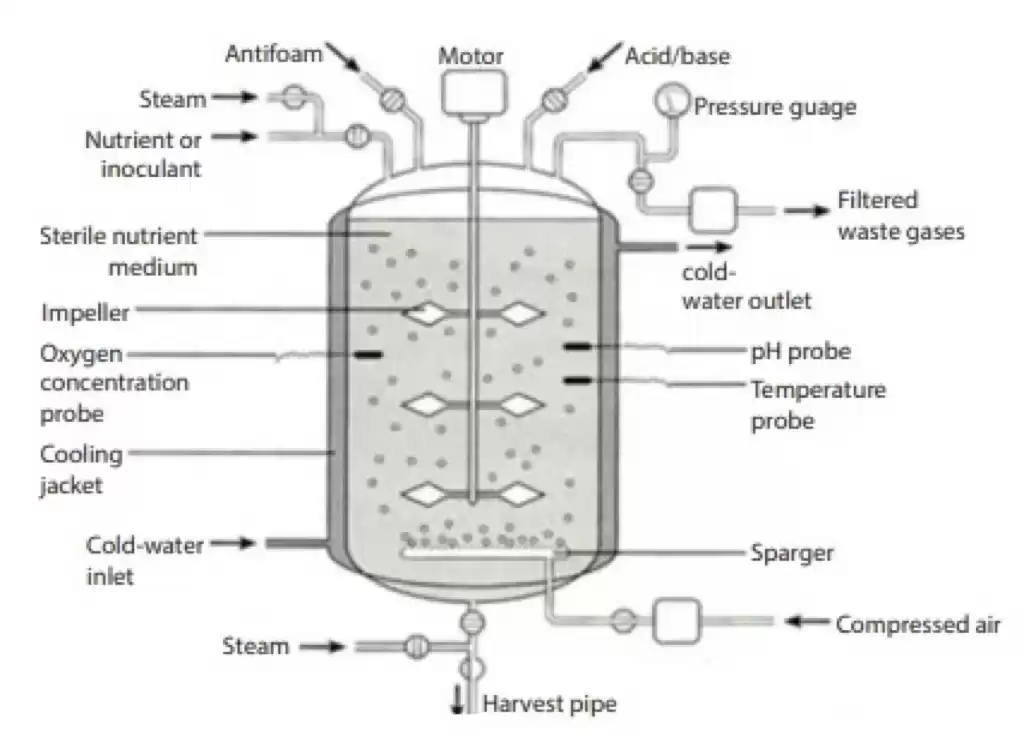
A good fermenter must have the following features: heat and oxygen transfer settings, sterilization process and foam control, fast and thorough cleaning system, appropriate monitoring and control systems.
Bioreactor components and their functions
•Traditional designs are open round or rectangular containers made of stone or wood.
•Most fermentations are done in closed systems to prevent contamination.
•It should be made of non-toxic and corrosion-resistant materials.
•Small fermenters with a capacity of only a few liters are made of glass or stainless steel.
•The pilot scale and various production vessels are made of stainless steel with polished internal surfaces.
•Large fermenters are usually made from mild steel and then lined with plastic or glass to reduce costs.
•If aseptic processing is required, the pipes transporting the inoculum, air, and fermentation raw materials must be sterilized, usually with steam.
•Most container cleaning processes are now automated using spray heads and are known as cleaning in place (CIP).
•Piping must be designed to limit the opportunity for microbial contamination. There should be no seams in the horizontal direction, nor should there be any unnecessary pipes and dead spaces where matter can accumulate; otherwise, the result may be ineffective sterilization.
•Usually, fermenters with a capacity of 1000 liters are equipped with jackets. Larger containers have internal coils.
•Safety and pressure gauge valves (required during sterilization and operation) should be used.
•To transport the media, centrifugal pumps (generating high shear forces and providing routes prone to contamination) magnetically coupled jets and peristaltic pumps are used.
•Alternative methods of liquid delivery include gravity feed or vessel pressure.
•In fermentations operating at high temperatures or containing volatile compounds, a sterilizable condenser may be required to prevent evaporative losses.
•Fermenters are usually run at positive pressure to prevent contaminants from entering.
◆Different parts of bioreactor
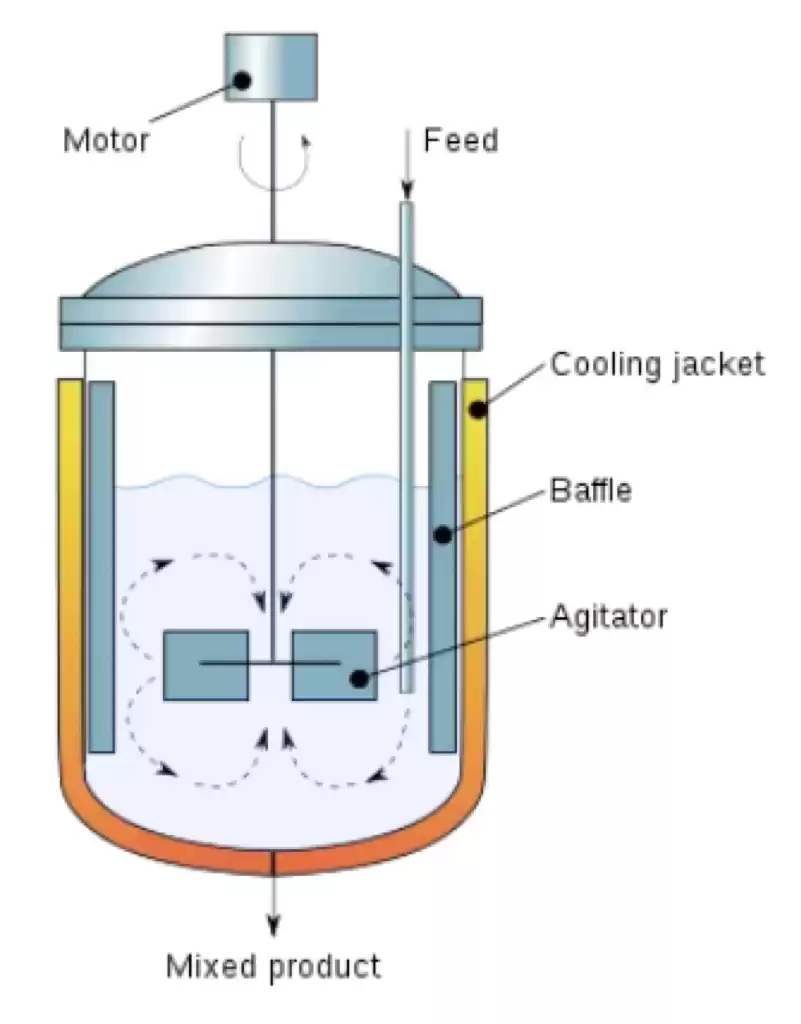
1 Fermentation tank/container
The vessel is designed so that minimal effort is required and it is maintained, working in a clean manner under carefully controlled conditions. The interior of the container is smooth and made of low-cost substances to provide optimal results. There are two types of fermentation tanks: glass fermentation tanks and stainless steel fermentation tanks. Glass is the first choice for small sizes, and stainless steel is used for industrial purposes.
•Glass is non-toxic and corrosion-resistant. It is easy to study the internal reactions within the container. Sterilize using an autoclave. They are small fermenters, measuring approximately 60 cm.
•Most stainless steel is used for large-scale fermentation. Containers are able to withstand corrosion and pressure. The sterilization process takes place in situ.
2 Heating and cooling equipment
The containers used to ferment food are created by the activity and agitation of microorganisms. The temperature in the container is controlled by adding or removing heat from the device. A thermostatically controlled bath and usually an internal coil for heat and a silicone jacket are used to remove the heat. It features dual silicon pads with heating wires sandwiched between them. If oversized and the mat is covered with a jacketed surface, dissipating heat in the internal coils is a pain and cold water must circulate to keep the temperature constant.
3 Seal components
4 Baffle
5 Impeller
Impellers are used to provide a uniform suspension of microbial cells in a homogeneous culture medium for delivery of nutrients through agitation. The impeller mixes the bulk liquid with the solid particles and gaseous phase of the suspended culture. Impellers with variable impellers are used in fermenters and can be classified according to.
•Disc turbines: They consist of a disc with a set of rectangular blades. They allow airflow from the distributor to hit the bottom of the disc, which then moves the air toward the blades, breaking up large bubbles into smaller ones.
•Variable pitch open turbines: They also include a mixer shaft that is boxed and connected to the marine propeller blades on the mixer shaft. The bubbles that make up this turbine do not touch any surface before being dispersed.
6 Distributor
7 Inlet
8 Foam control
This is one of the most important components of the fermenter, as the foam volume within the vessel must be reduced to prevent contamination. Foam levels can be controlled via two components: Foam Sensing and Control. In the fermenter, the probe is placed through the top and set to a level above the surface. If the foam level rises and contacts the probe tip, an electric current will flow through the circuit. The electric current will activate the pump and the antifoam agent will be released immediately to solve the problem.
9 Valve
Valves are used in fermenters to control the flow of liquid within the vessel. There are about five types of valves used, including globe valves, butterfly valves, ball valves, diaphragm valves and butterfly valves. Globe valves can be used for general purposes, but they do not control flow. Butterfly valves are not suitable for use under sterile conditions. They are used in large diameter pipes operating at low pressures. Ball valves can be used under sterile conditions. They can handle mycelial broths and operate at high temperatures. Diaphragm valves help regulate flow.
10 Safety valve
Safety valves are integrated in the pipe and air layout and operate under pressure. Through these valves, the pressure is maintained within a safe range.
11 Aeration system
•A fermenter’s aeration system is probably one of its most important components.
•To ensure adequate oxygen supply throughout the cultivation process, it is crucial to choose a reliable aeration system.
•It has two independent aeration devices, an impeller and a distributor to ensure proper aeration of the fermenter.
Stirring accomplishes two things:
•It allows you to mix air bubbles in liquid media.
•It allows microbial cells to mix through a liquid medium, ensuring they have equal access to nutrients.
12 Foam control
13 Environmental factor control device
14 Fermentation tank using computer